How to Budget for Solo Travel …when you’re not 22 and backpacking
Let's be honest - most "solo travel budget" content online is written for 20-somethings with a hostel dorm bed and a backpack. That's not you. That’s not me.
You're not trying to stretch $15 a day across three months in Southeast Asia. You're planning a real trip — 4 to 14 days, somewhere you actually want to be, with a bed you'll sleep well in and money left over for the experiences that make the trip worth it.
So let's talk about what solo travel budgeting actually looks like for a woman in her 40s, 50s or 60s, at every comfort level from "keep it simple" to "I've earned the 5 stars."
First of all— did you know??
Traveling solo costs more per day than traveling with a partner or a group — not because you're bad at budgeting, but because you can't split the room. Solo travel typically runs 30-60% more per day than the same trip taken as a couple, and 40-70% more than the same trip split four ways.
That $200/night boutique hotel a couple pays $100 each for? You're paying the full $200. OUCH
BUT its not a reason to stay home or a reason that you can’t go solo! Don’t let that stop you!
6 CATEGORIES THAT MAKE UP A TRAVEL BUDGET
Lodging — the single biggest line item, and where solo travelers feel the "solo tax" most
Food — street tacos to tasting menus, this swings more than any other category
Local transport — airport transfers, metro/taxi/rideshare, day-trip transportation
Activities — tours, museums, spa days, experiences
Gear & prep — the stuff you buy before you go (adapters, luggage, that one dress)
Buffer — travel insurance, the "oh no" fund for the unexpected

free printable worksheet designed to help you organize your travel expenses, estimate your trip costs, and create a personalized travel budget based on your destination and travel style
Wait —why isn't airfare included in these numbers?
Good question- I did this on purpose. Every budget below covers what you spend once you land — flights are left out because airfare has nothing to do with the destination's cost of living. It depends entirely on where you're flying from, how far ahead you book, and the season. Bundling it in would make the daily numbers useless. My flight and your flight to the same city could be $300 apart.
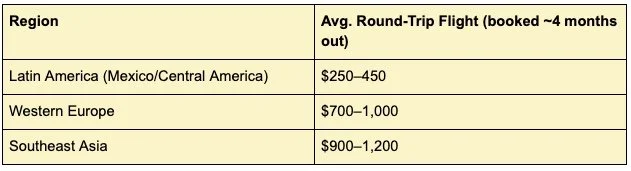
So here's flights as their own line item — average round-trip economy fares from the US, booking about 4 months out:
Make it stand out
Whatever it is, the way you tell your story online can make all the difference.
A few notes on timing: 3-5 months out is the sweet spot for Europe, while Asia and Oceania reward booking even earlier — 5-7 months ahead — since fares climb faster the closer you get to departure on those longer routes. Mexico and Central America are more forgiving; even 4-8 weeks out often still gets you a reasonable fare.
Budgeting by Region (because $100/day is different in each region!)
I’m starting with the regions solo travelers ask about most and head to most often — but stay tuned, I'll keep expanding this guide as more destinations come into focus.
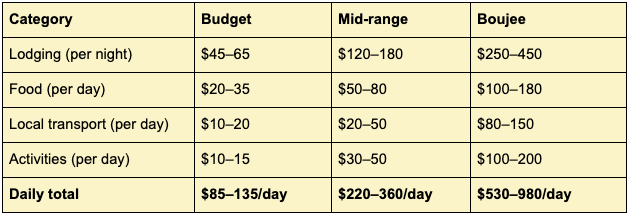
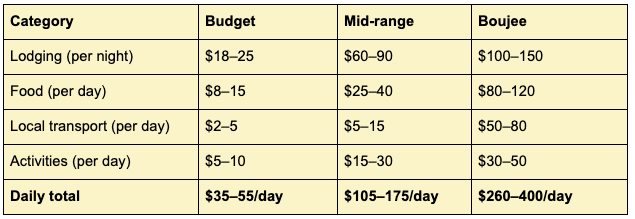
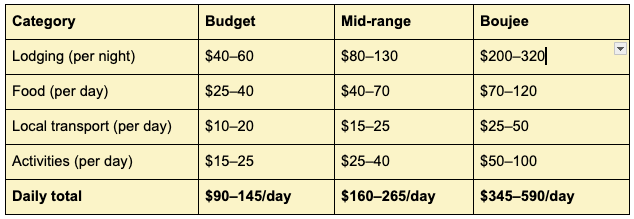
NOTE: These are AVERAGE costs! Paris, France, will be way more expensive than going to Porto, Portugal. Please do your own research.
🚗 USA: DOMESTIC
Make it stand out
Whatever it is, the way you tell your story online can make all the difference.
🌴 LATIN AMERICA: MEXICO/ CENTRAL AMERICA
🏰 WESTERN EUROPE: ITALY, SPAIN, UK
🛖 SOUTHEAST ASIA: THAILAND, BALI, VIETNAM
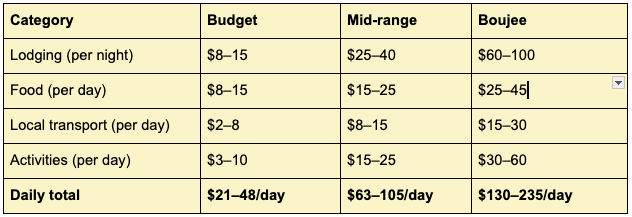
Below are some budget tips and tricks that I use!
📅 Travel during shoulder season. You'll often find lower airfare, cheaper accommodations, and fewer crowds.
🍎 Carry snacks. Airport food and tourist-area snacks are expensive! A protein bar in your backpack can save you from spending $12 on one freaking bag of chips.
💧Bring a reusable water bottle. The airports, hotels, colivings, Airbnbs, and hostels have filtered water. Refilling instead of buying bottled water every day adds up quickly. (I save SO much with this & it’s good for the planet!)
💵 Skip the airport ATM. They usually have the highest fees and the worst exchange rates. Instead, withdraw cash from a bank ATM once you're in the city and always choose to be charged in the local currency (not US dollars).
💳 Check your credit card before you travel. Make sure it doesn't charge foreign transaction fees. Those small fees can add up quickly over the course of your trip. (I learned the hard way!)
🥐 Eat one nice meal a day. I'll usually splurge on either lunch or dinner, then keep the other meal simple. And usually I only eat half, then save the rest for the next day!
🍳 Book accommodations with a kitchen. Even making breakfast and coffee at home each morning can save you $15-30 a day. I usually cook a few dinners too.
🛒 Shop at local grocery stores. It's one of my FAVORITE ways to save money and see how locals actually live.
🚶♀️ Use FreeTour.com for a free tour of the city. You can find a lot of free walking tours in the area or donation-based and not super crowded.
🗺️ Have a transportation game plan. Before I arrive somewhere new, I like to know how I'm getting from the airport to my accommodations and what the easiest way is to get around the city. It saves money, but more importantly, it helps me feel more confident exploring on my own.
What about the nomad life?
I get this question constantly in the community: "Could I actually do the digital nomad thing?"
Here's my honest, lived-in answer: I don't have a set monthly budget. Mine swings anywhere from $1,500 to $3,000 a month, and I try to keep $3,000 as my max. The number moves depending on the trade-offs I'm making that month.
Here's what that actually looks like:
House sitting or pet sitting = $0 on accommodation. When that happens, I let myself spend more on activities and tours, or just build up a bigger cushion.
Booking an Airbnb (say, $2,000/month) means I pull back elsewhere — I'm buying groceries and cooking most meals instead of eating out.
A pricier flight to the next country ($500, for example) means I budget tighter on lodging that month — a $30/night coliving instead of a $50/night Airbnb.
It's not a fixed formula. It's a constant trade-off between flights, lodging, and food — and knowing which lever to pull when one category costs more. That's the real skill of nomad budgeting: not hitting an exact number every month, but knowing your ceiling and adjusting the pieces underneath it.
The bottom line
You don't need to choose between "backpacker" and "boujee." Pick your comfort level, plug it into your destination's range, and build from there. Maybe you spend more money on the accommodations and less money going out. What means more to you?
I tend to spend a little more on getting a private transfer from the airport to the accommodations, because I feel that puts my mind at ease knowing that I have a safe ride. But others would spend more money on a 5 Star or a Michelin restaurant and save on cheaper stays.
Decide what matters most to you and go from there.
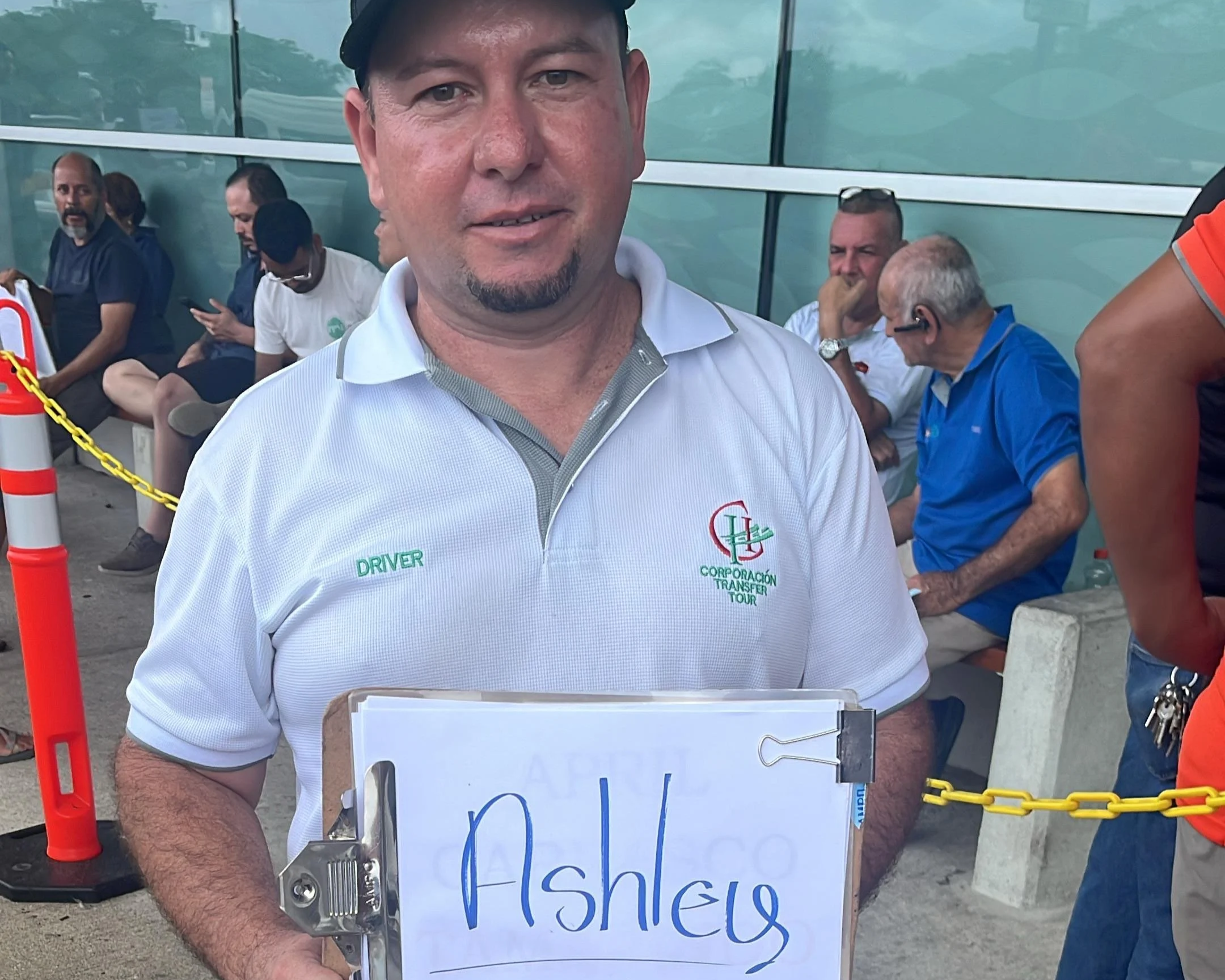
This was Jorge who was my driver from Liberia Airport (Costa Rica) to the 1.5 hour drive to Tamarindo!
I felt so much better having someone there to pick me up, instead of finding a Uber or taxi. I use Welcome Pickups and I always have a great experience and feel safe.
Want to build out your own line-by-line trip budget — insurance, eSIM, every last detail included? Grab my free Solo Travel Budget Worksheet and plug in your own numbers.
P.S. If Mexico City is on your list, I put together a full solo travel guide + 3-day itinerary with real budget numbers for every stop. Check it out here it's $17 and it'll save you hours of planning.
DISCLOSURE: Some of the links on this site are affiliate links, which means I may earn a small commission if you make a purchase or booking through them, at no extra cost to you. For details, see our Privacy Policy.